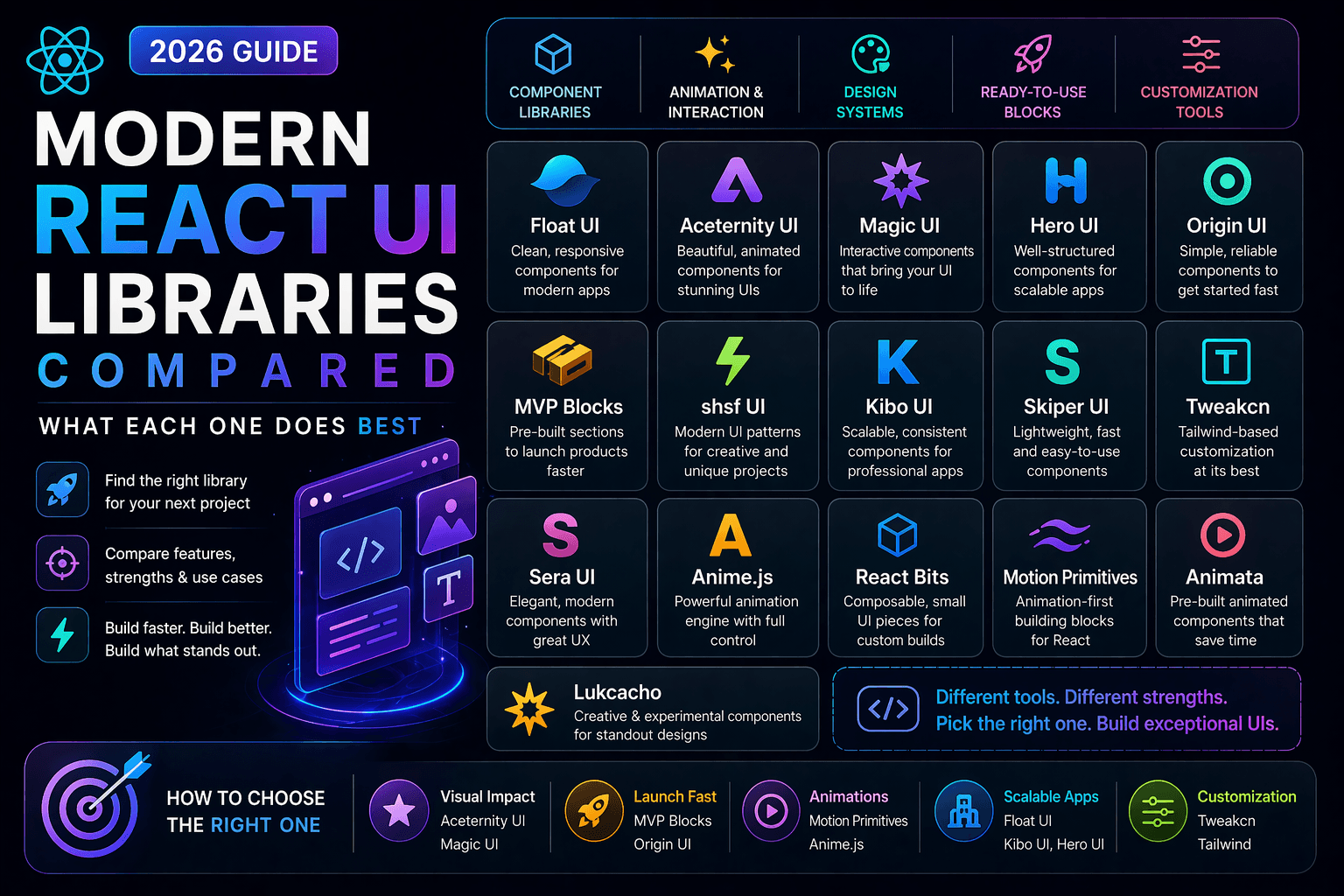
Stop Treating All UI Libraries the Same
Most blogs lump UI libraries together like they do the same thing. They don’t. Some are animation engines, some are component kits, and some are just design systems with better defaults.
Choosing the wrong UI library won’t break your app - but it will make it painfully average.
Library-by-Library Breakdown
Float UI
Float UI focuses on clean, responsive, production-ready components without heavy styling opinions. It’s ideal when you want a polished UI but still maintain control over design.
- Minimal and clean components
- Good for SaaS dashboards
- Easy to customize without fighting defaults
Aceternity UI
Aceternity UI is built for visual impact. It provides highly animated, aesthetic components designed for landing pages and personal brands.
- Scroll-based and motion-heavy components
- Perfect for portfolios and landing pages
- Focus on visual storytelling
Magic UI
Magic UI emphasizes interaction. It provides components that feel dynamic and alive, making it ideal for apps that rely on engagement.
- Highly interactive components
- Great micro-interactions
- Improves perceived performance
Hero UI
Hero UI focuses on reusable, structured components that are easy to scale in larger applications.
- Well-structured components
- Good for scalable apps
- Balanced between design and usability
Origin UI
Origin UI provides solid base components that are ideal for starting new projects quickly without overcomplicating design.
- Simple and reliable
- Fast setup for new projects
- Low learning curve
MVP Blocks
MVP Blocks is designed for speed. It gives you ready-made sections and layouts so you can launch products quickly.
- Pre-built sections (hero, pricing, etc.)
- Perfect for startups
- Rapid prototyping
shsf UI
shsf UI is focused on experimental and modern UI patterns, offering unique components that stand out from traditional design systems.
- Unique design patterns
- Modern UI experiments
- Good for creative projects
Kibo UI
Kibo UI provides structured and scalable components tailored for professional applications and dashboards.
- Enterprise-friendly structure
- Consistent design system
- Good for dashboards
Skiper UI
Skiper UI focuses on simplicity and speed, helping developers build clean interfaces quickly.
- Lightweight components
- Fast development
- Minimal overhead
Tweakcn
Tweakcn is not just a UI library - it’s a customization tool for Tailwind-based components, allowing deep control over styling.
- Advanced customization
- Works well with Tailwind
- Great for design consistency
Sera UI
Sera UI provides elegant and modern components with a focus on aesthetics and usability.
- Clean and modern design
- User-friendly components
- Balanced visuals
Anime.js
Anime.js is a powerful animation engine rather than a UI library. It gives you full control over animations at a low level.
- Precise animation control
- Timeline-based animations
- Works beyond React
React Bits
React Bits provides small reusable UI pieces instead of full systems, making it flexible for custom builds.
- Composable components
- Lightweight
- Flexible usage
Motion Primitives
Motion Primitives is built for animation-first development, providing reusable motion-based building blocks.
- Reusable animation patterns
- Built for motion-heavy apps
- Works well with Framer Motion
Animata
Animata focuses on pre-built animated components that save time while still looking modern.
- Prebuilt animations
- Easy integration
- Improves UI feel instantly
Lukcacho
Lukcacho is a niche collection of creative UI components aimed at unique and experimental designs.
- Creative components
- Non-traditional UI patterns
- Best for standout designs
How to Choose the Right One
- Use Aceternity or Magic UI for visual-heavy projects
- Use MVP Blocks for fast product launches
- Use Motion Primitives or Anime.js for animations
- Use Float, Kibo, or Hero UI for scalable apps
- Use Tweakcn for deep customization
Final Thoughts
There is no single 'best' UI library. The best one depends on your goal - speed, animation, scalability, or design uniqueness. Knowing what each library is actually good at is what separates average developers from great ones.